
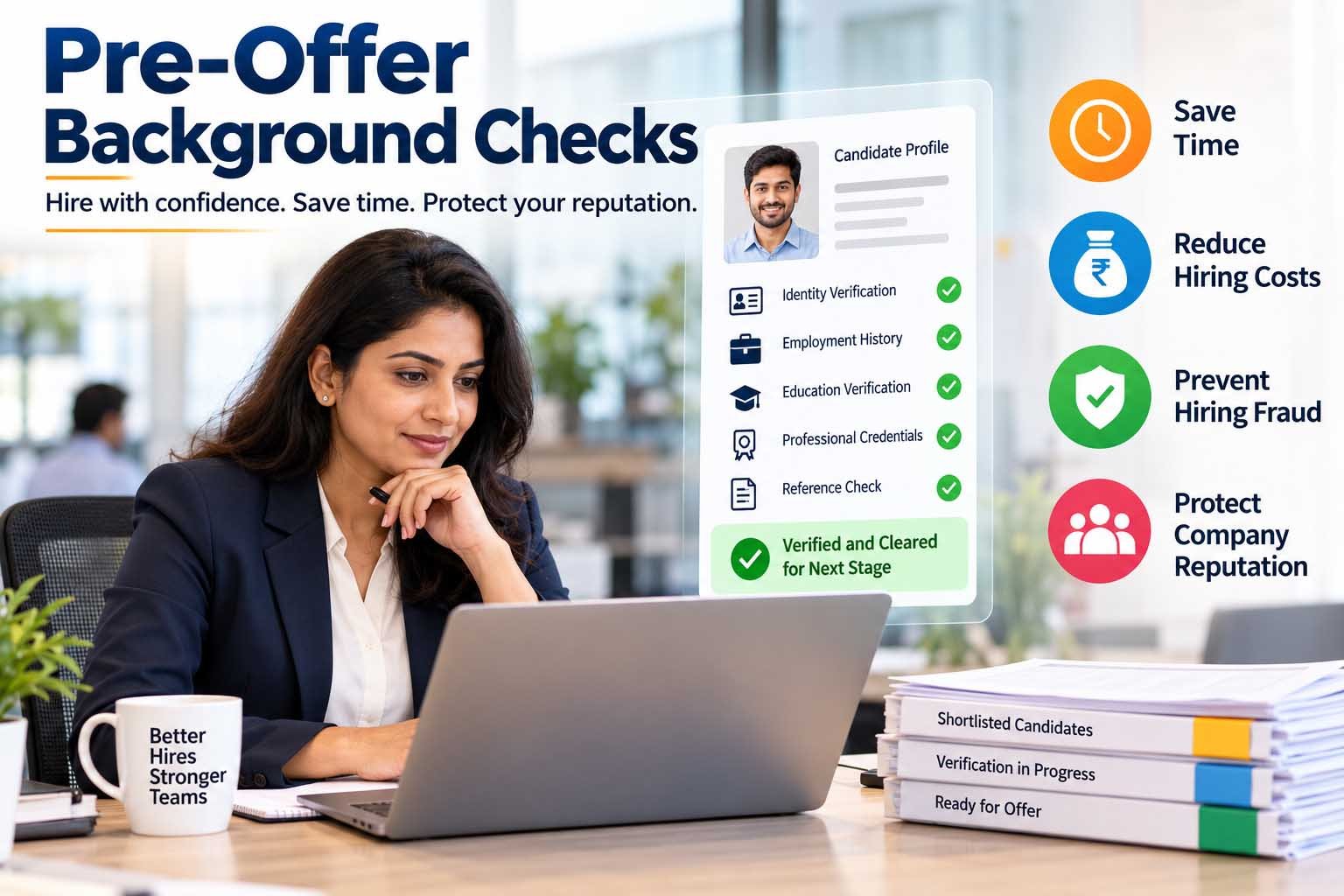
Pre-Offer Background Checks: How Recruiters Can Save Time, Reduce Hiring Costs and Protect Company Reputation
Recruitment is one of the most important business processes in any organisation. Hiring the right employees helps companies improve productivity, build customer trust and achieve long-term business goals. However, hiring the wrong candidate can create significant problems, including wasted recruitment budgets, delayed projects, compliance concerns, workplace disruption and reputational damage.
Recruiters often invest considerable time and effort in sourcing candidates, reviewing resumes, conducting interviews, coordinating assessments and negotiating salaries. After all this work, discovering that a candidate has misrepresented their qualifications, employment history or professional credentials can force the organisation to restart the hiring process.
This is where pre-offer background checks become valuable.
Pre-offer background checks involve verifying relevant information about a job candidate before extending a formal employment offer. Depending on the role, the verification process may include identity checks, employment history verification, education verification, professional licence validation and other relevant, lawful checks.
By identifying material discrepancies early, employers can make better-informed hiring decisions before committing significant time and resources to onboarding a candidate.
For recruiters, the objective is not simply to find reasons to reject applicants. It is to establish whether the information provided by shortlisted candidates is sufficiently accurate, relevant and reliable for the responsibilities of the position.
A well-designed pre-offer background verification process helps organisations recruit more efficiently, minimise avoidable costs and protect their reputation without creating unnecessary delays for genuine candidates.
What Are Pre-Offer Background Checks?
Pre-offer background checks are verification activities undertaken during the recruitment process, usually after a candidate has been shortlisted and before a formal employment offer is issued.
The scope of verification depends on the position, the organisation’s policies, applicable law and the risks associated with the job.
For example, an organisation recruiting a senior finance manager may need to verify employment history, qualifications, professional credentials and other role-relevant information. A company hiring an engineer may prioritise educational qualifications, previous employment and any professional registration required for the position.
A pre-offer verification process may include:
- Identity verification: Confirming that the candidate’s identity details are consistent with the documents and information provided.
- Employment verification: Checking previous employers, employment dates, job titles and other relevant employment details.
- Education verification: Validating academic qualifications with the issuing institution or an authorised source.
- Professional credential checks: Confirming licences, registrations or certifications required for the role.
- Reference checks: Obtaining relevant professional references, where appropriate and with due regard to consent and privacy.
- Other role-relevant checks: Conducting additional checks only where lawful, proportionate and justified by the job’s responsibilities.
Not every check is appropriate for every position. Recruiters should define the verification requirements before recruitment begins rather than applying the same broad set of checks to every applicant.
The key principle is straightforward: verify important claims early enough to inform the hiring decision.
1. Save Recruiters’ Time by Identifying Discrepancies Early
Recruitment teams work under constant pressure to fill vacancies quickly. Every additional interview, assessment, approval and follow-up consumes time that could otherwise be spent progressing suitable candidates.
Consider a common situation. A candidate successfully completes three rounds of interviews, receives internal approval and enters salary negotiations. The recruiter then discovers that the candidate’s stated employment dates do not match the records confirmed by a previous employer.
The organisation must now investigate the discrepancy, consult the hiring manager, reconsider the candidate’s suitability and potentially restart recruitment.
If the discrepancy is material and cannot be resolved, much of the work invested in the candidate may be wasted.
Pre-offer background checks help identify such issues earlier in the recruitment funnel. Recruiters can investigate relevant discrepancies while the candidate is still being assessed, rather than discovering them after the organisation has invested heavily in the hiring decision.
This can help reduce:
- Repeated interviews for candidates who do not meet essential requirements.
- Last-minute escalations to HR and hiring managers.
- Time spent revisiting recruitment decisions.
- Delays caused by replacing unsuitable candidates.
- Administrative work associated with withdrawing or revising an offer.
Early verification does not eliminate every hiring problem. Some information may be difficult to verify, and not every discrepancy indicates deliberate misrepresentation. Nevertheless, an appropriately timed process gives recruiters an opportunity to clarify concerns before they become more expensive to resolve.
2. Reduce the Cost of Recruitment
Recruitment costs involve far more than advertising a vacancy. They include recruiter salaries, recruitment agency fees, assessment platforms, interview time, hiring-manager involvement, administrative support and the opportunity cost of keeping a position vacant.
When a candidate is found unsuitable late in the process, these costs may need to be incurred again.
Imagine a business recruiting a specialist employee for a critical project. The recruitment team spends several weeks finding and assessing the preferred candidate. After an offer is accepted, a material qualification discrepancy emerges. The company must reopen the vacancy, repeat assessments and negotiate with another candidate.
The initial recruitment investment has not generated the intended outcome.
Pre-offer background verification can reduce the likelihood of this scenario by bringing essential facts into the decision-making process earlier.
It can also support more efficient use of recruitment agencies. Where an organisation pays for successful placements, discovering material discrepancies before the offer stage may help prevent avoidable expenditure on candidates who do not meet clearly defined requirements.
To assess the financial value of a programme, organisations can track:
- Average recruitment cost per successful hire.
- Recruiter hours spent per vacancy.
- Number of offers withdrawn because of verified discrepancies.
- Cost of restarting a recruitment process.
- Average time taken to fill a vacancy.
- Cost and frequency of post-offer verification escalations.
These measures help employers determine whether their verification process is delivering practical value. The goal is not to maximise the number of checks, but to identify important issues efficiently and proportionately.
3. Prevent Hiring Fraud and Misrepresentation
Resumes and job applications provide important information, but they are not independent proof of every claim a candidate makes.
A candidate may unintentionally enter an incorrect date, overstate a responsibility or describe a qualification imprecisely. In other cases, a candidate may deliberately misrepresent their employment history, academic achievements or professional credentials.
Recruiters may find such claims difficult to assess through interviews alone. A confident presentation does not necessarily establish that every detail in a CV is accurate.
Pre-offer background checks provide an additional layer of evidence.
Employment verification can help establish whether a candidate worked for a stated employer during the claimed period. Education verification can confirm whether the stated qualification was awarded by the institution. Professional credential checks can help determine whether a licence or certification is genuine and valid, where such confirmation is available.
These checks are particularly important when a position depends on specific qualifications, regulated credentials, specialist expertise or a history of relevant professional experience.
For example, a discrepancy involving the completion of a mandatory professional qualification may be critical to a role. A minor difference in how an earlier job title was written may be less significant, especially if the candidate’s actual responsibilities are otherwise consistent.
Recruiters should assess discrepancies according to their materiality, relevance and explanation. Verification should help establish the facts, not encourage automatic rejection whenever information differs slightly.
4. Protect the Company’s Reputation
A company’s reputation is built through the actions of its employees, the quality of its services, its conduct towards customers and its ability to manage risk responsibly.
Hiring decisions can influence all these areas.
Employees may represent a company in customer meetings, handle sensitive information, manage money, access business systems or make decisions that affect customers and suppliers. If essential qualifications or employment claims are not verified where appropriate, the organisation may expose itself to avoidable operational or reputational risks.
The consequences can be particularly serious when an employee’s misrepresented credentials affect professional services, financial controls, customer safety or a position of trust.
For example, if a role requires a current professional licence, failing to verify that requirement could create operational, legal or customer-confidence problems. Similarly, an employee appointed to a sensitive financial position without adequate checks may create risks that more careful recruitment controls could have helped identify.
Pre-offer background checks cannot guarantee that every employee will behave appropriately or perform well. Nor can they eliminate all fraud, misconduct or workplace incidents. Their value lies in helping organisations validate important information before making consequential hiring decisions.
A documented, consistent verification policy also demonstrates that the company takes recruitment risk seriously and uses a structured process to assess candidates fairly.
5. Avoid the Costs and Disruption of Replacing a New Hire
Discovering a material discrepancy after an employee has joined the organisation can be much more complicated than discovering it before an offer is made.
By that point, the company may have completed induction, created system accounts, allocated equipment, introduced the employee to customers and colleagues, and assigned responsibilities. Managers may have already reorganised workloads around the new hire.
If a significant issue later requires the company to reconsider the appointment, the consequences may include:
- Lost productivity during onboarding.
- Time spent reviewing the matter and documenting the decision.
- Disruption to projects and team responsibilities.
- Recruitment costs to replace the employee.
- Potential legal or contractual complications.
- Damage to confidence among colleagues, customers or stakeholders.
The exact cost varies by position, sector and organisation. Senior, specialist and business-critical positions can be especially expensive to refill because finding a suitable replacement may take considerable time.
Pre-offer verification provides an opportunity to clarify important facts before these additional commitments arise.
However, employers should still apply their agreed recruitment and verification policies consistently. An inconclusive result should prompt appropriate investigation rather than an automatic assumption that the candidate is unsuitable.
6. Improve Hiring Decisions With Evidence, Not Assumptions
Recruitment decisions can be influenced by personal impressions, interview performance, referral relationships and pressure to fill an urgent vacancy.
Background verification adds an evidence-based component to this process.
Suppose two candidates perform similarly during interviews. One candidate’s essential qualifications and employment history are verified, while the other has a material discrepancy in a credential required for the position.
The recruiter now has relevant additional information to consider alongside interview scores, demonstrated skills, references and other selection criteria.
This does not mean that a candidate with a discrepancy should always be rejected. The recruiter should understand the nature of the difference, allow an appropriate opportunity for clarification and determine whether the issue affects the role’s requirements.
A reliable process separates facts from assumptions. It also distinguishes between a verified discrepancy, an unresolved concern and a confirmed instance of deliberate misrepresentation.
This distinction is essential for fair hiring decisions and helps organisations avoid unfairly disadvantaging candidates because of administrative errors or inaccurate third-party records.
7. Create a More Efficient Recruitment Funnel
Recruitment usually moves through several stages: application screening, interviews, assessments, shortlisting, final selection, offer approval and onboarding.
When relevant verification is left until the very end, the organisation may discover that its preferred candidate does not meet an essential requirement after much of the process has been completed.
A well-planned pre-offer verification workflow can help reduce this risk.
A practical pre-offer verification workflow
Step 1: Identify critical requirements. Define the qualifications, employment experience, licences and other credentials essential to the role.
Step 2: Decide when to verify. Conduct the checks at an appropriate stage after shortlisting, balancing the value of early information against cost, candidate experience and privacy.
Step 3: Inform the candidate. Explain the purpose and scope of the checks, obtain consent where required and provide clear instructions on any documents or details needed.
Step 4: Verify relevant information. Use appropriate sources and authorised verification methods to check material claims.
Step 5: Review discrepancies. Assess inconsistencies carefully, request clarification and allow reasonable time for the candidate to respond.
Step 6: Make the hiring decision. Consider verified results alongside interviews, skills, experience and role requirements.
Step 7: Document the outcome. Maintain appropriate records of the process, decision rationale and any required follow-up, subject to applicable privacy and retention requirements.
This workflow enables recruiters to work systematically without making background verification a last-minute administrative hurdle.
8. Make Better Use of Recruiter and Hiring-Manager Resources
Recruiters are responsible for much more than scheduling interviews. They manage candidate relationships, communicate with hiring managers, negotiate compensation, coordinate approvals and maintain recruitment pipelines.
Every avoidable hiring issue consumes time that could have been used to progress other vacancies.
Hiring managers also face competing priorities. Repeatedly reviewing candidates because of preventable eligibility or credential issues can distract them from business operations and strategic work.
A structured pre-offer verification process helps focus these resources on candidates who meet essential, verified requirements.
It can also reduce unnecessary communication between recruiters, HR, compliance teams and hiring managers by clarifying which checks are required, who reviews the results and how unresolved issues are escalated.
Technology can support this process by simplifying candidate consent, document collection, verification requests, status tracking and report management. Automated workflows may reduce repetitive administrative tasks, although they should not replace human review where results are ambiguous or decisions could materially affect a candidate.
The best process combines technology, clear policies and accountable decision-making.
9. Strengthen Compliance and Recruitment Governance
Employers often operate under internal hiring policies, client requirements, sector-specific obligations and applicable employment and privacy laws.
Certain roles may require particular qualifications, registrations or suitability checks. Where those requirements apply, verifying them at the appropriate stage can help the employer avoid preventable compliance issues.
Pre-offer checks can also create a consistent audit trail showing that the organisation followed its stated recruitment procedure.
For effective governance, employers should:
- Define which checks are appropriate for each role.
- Obtain consent and provide relevant notices where required.
- Collect only information that is relevant and proportionate.
- Restrict access to verification results.
- Establish clear procedures for reviewing discrepancies.
- Apply fair, consistent criteria to comparable candidates.
- Retain and dispose of candidate information according to applicable requirements.
A background check should not be treated as permission to collect unlimited personal information. Employers should avoid checks that are irrelevant to the position and ensure that decisions comply with applicable privacy, employment, discrimination and data-protection rules.
Where checks return sensitive, adverse or inconclusive information, access should be restricted to authorised decision-makers who have a legitimate need to review it.
10. Maintain a Positive Candidate Experience
Some employers hesitate to conduct checks before making an offer because they worry about delaying recruitment or discouraging good candidates.
These concerns can often be addressed through clear communication and a proportionate process.
Candidates should know which information will be verified, why the checks are necessary and how their information will be handled. Requests should be straightforward, deadlines reasonable and progress updates timely.
Employers should also avoid presenting background verification as an accusation. It is a standard recruitment control designed to verify role-relevant information consistently.
Where possible, recruiters should explain the process early enough for candidates to prepare the required information. If a discrepancy arises, the candidate should have an opportunity to provide context or supporting evidence before a decision is finalised.
This approach benefits both parties. Recruiters receive better-quality information, while candidates understand the process and have a fair opportunity to resolve errors.
A positive candidate experience can coexist with robust verification. The two are not competing objectives when the process is transparent, efficient and respectful.
11. Pre-Offer Checks Versus Post-Offer Background Verification
Employers do not necessarily need to complete every check before extending an offer. The appropriate timing depends on the position, the complexity of verification, the urgency of recruitment and applicable rules.
Nevertheless, understanding the difference between pre-offer and post-offer checks helps organisations design a more effective recruitment policy.
| Factor | Pre-offer background checks | Post-offer background checks |
|---|---|---|
| Timing | Before a formal offer is issued | After an offer has been issued |
| Primary benefit | Informs the initial hiring commitment | Supports final clearance before joining or continued employment, depending on the arrangement |
| Potential cost savings | May prevent some avoidable offers and repeat recruitment | May identify issues after offer-related costs have already arisen |
| Recruitment speed | Can prevent late-stage surprises when managed efficiently | Can delay joining if concerns emerge near the start date |
| Candidate communication | Requirements are explained during selection | Requirements are explained after an offer |
| Best use | Verifying essential claims that materially affect selection | Completing checks that are appropriately scheduled later or require additional time |
For many organisations, a staged approach works well: verify critical role requirements before the offer and complete additional appropriate checks later where necessary and lawful.
The objective is to identify important issues at the earliest reasonable point, without delaying recruitment through checks that are unnecessary or premature.
12. How Recruiters Can Measure the Value of Pre-Offer Background Checks
Background verification should be evaluated as part of the recruitment process, not simply as a standalone administrative expense.
Recruitment teams can monitor several indicators to understand its impact:
Time to hire: Does earlier identification of discrepancies reduce delays and repeated recruitment activity?
Recruitment cost per hire: Are there fewer avoidable recruitment cycles and replacement searches?
Verification turnaround time: How quickly are relevant checks completed, and which stages create bottlenecks?
Discrepancy resolution rate: How often are inconsistencies clarified successfully, and how many remain unresolved?
Offer withdrawal rate: How frequently do offers need to be withdrawn because a material issue is identified? A decrease may be useful to track, but it should not be the sole measure of success.
Candidate experience: Do candidates understand the process, receive timely updates and have a fair opportunity to clarify results?
Quality of hire: Do verified qualifications and employment claims correspond with the requirements of the role? This should be assessed alongside performance and other appropriate indicators.
These measures help companies refine their verification policies. They can identify which checks deliver meaningful value, where administrative delays occur and how to improve the candidate experience.
A successful programme is not necessarily the one that identifies the most discrepancies. It is the one that consistently provides relevant, reliable information in time to support better hiring decisions.
Common Mistakes to Avoid When Conducting Pre-Offer Background Checks
Even a well-intentioned verification programme can create problems if it is poorly designed.
Checking every candidate in the same way: Different positions create different risks. Define the checks according to job responsibilities and applicable requirements.
Starting too late: Waiting until the candidate is about to join may reduce the opportunity to resolve concerns before committing resources.
Treating every discrepancy as fraud: Differences can arise from data-entry errors, name variations, date formats or incomplete records. Investigate before drawing conclusions.
Relying on a name match alone: Similar names can belong to different people. Use appropriate identifiers and manual review to reduce false matches.
Failing to communicate with candidates: Unclear requests and unexplained delays can damage trust and lead to avoidable withdrawals.
Overlooking privacy and fairness: Collect and use information lawfully, securely and proportionately, and provide an appropriate process for candidates to respond to material findings.
Assuming a clean report guarantees good performance: Background checks verify selected facts; they do not predict every aspect of future conduct, competence or reliability.
Frequently Asked Questions (FAQs)
1. What are pre-offer background checks?
Pre-offer background checks are verification activities conducted before a formal employment offer is issued. Depending on the role, they may include identity, education, employment history, professional credentials and other relevant checks.
2. Why should recruiters conduct background checks before making an offer?
Pre-offer background checks can help recruiters identify material discrepancies early, avoid preventable recruitment costs, reduce repeated hiring work and make better-informed decisions before committing further resources to a candidate.
3. Are pre-offer background checks mandatory for every job?
No. The checks required or permitted depend on the role, the employer’s policy and applicable law. Employers should determine which checks are necessary and legally appropriate rather than using a blanket approach for every vacancy.
4. Which background checks should be completed before an offer?
Employers should prioritise checks of information that materially affects eligibility or suitability for the position, such as essential qualifications, employment experience and mandatory professional credentials. Additional checks should be role-relevant and conducted lawfully.
5. Can pre-offer background checks reduce recruitment costs?
They can help reduce avoidable costs by identifying material discrepancies before an employer commits further resources to interviews, offer processing, onboarding and replacement recruitment. The actual savings depend on the role, process and verification costs.
6. What should a recruiter do if a background check identifies a discrepancy?
The recruiter should verify the source, assess the relevance of the discrepancy, give the candidate an appropriate opportunity to clarify it and document the outcome. A discrepancy should not automatically be treated as deliberate misrepresentation.
7. Do pre-offer checks replace post-offer background verification?
Not necessarily. Some organisations use a staged process in which critical information is verified before the offer and other appropriate checks are completed later. The timing should reflect the role’s requirements and applicable rules.
8. How can companies make pre-offer background checks faster?
Companies can define role-based checklists, communicate requirements early, obtain candidate consent where required, use reliable verification channels, automate routine status updates and establish clear procedures for reviewing exceptions.
Conclusion: Make Background Verification an Integral Part of Recruitment
Recruitment is a significant investment of time, money and management attention. Yet employers can undermine that investment when important candidate information is verified only after an offer has been made or onboarding has begun.
Pre-offer background checks help recruiters make informed hiring decisions before avoidable costs and commitments accumulate. By verifying essential qualifications, employment history and other role-relevant information at the appropriate stage, employers can reduce unnecessary recruitment work, identify discrepancies earlier and strengthen recruitment governance.
The benefits extend beyond cost savings. A structured approach supports fairer decisions, more efficient resource allocation, better candidate communication and greater protection against preventable hiring risks.
Background verification should not be used to make recruitment unnecessarily complicated or to reject candidates on the basis of unverified assumptions. It should be a proportionate, transparent and evidence-based process that helps employers establish the facts.
For organisations seeking to improve hiring efficiency and protect their reputation, the practical principle is clear: verify critical information early, investigate discrepancies fairly and make the hiring decision with reliable evidence.