
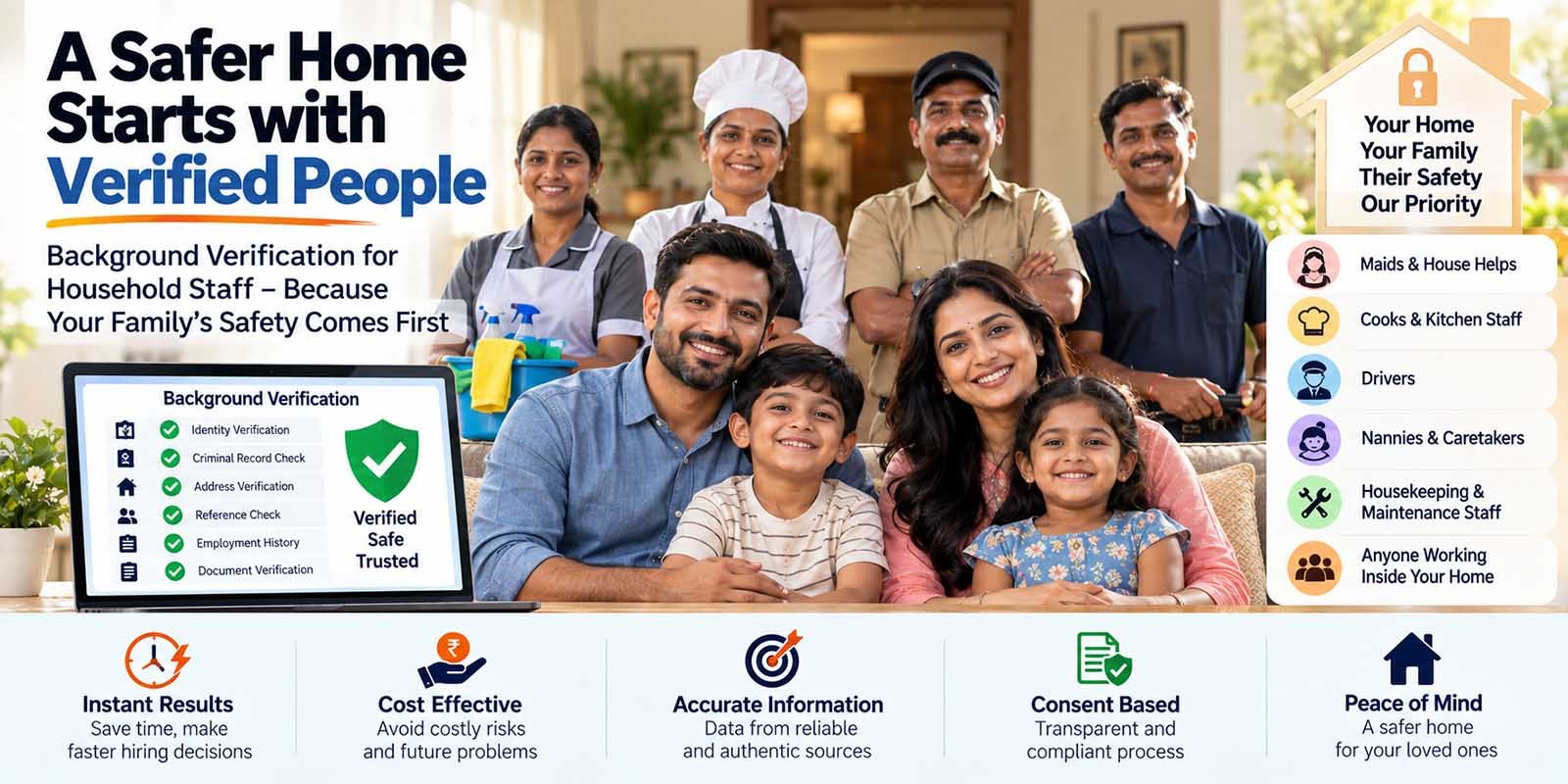
Domestic Staff Background Verification: Is Your Family Safe, or Are You Taking an Unnecessary Risk?
Secondary Keywords: Domestic help background check, maid police verification, maid background verification online, house help verification, nanny background check, cook background verification, driver background check, criminal record check for domestic workers, online background verification India.
Introduction: You Trust Them With Your Home. But Have You Verified Them?
Every day, families across India welcome domestic workers into their homes. Maids clean bedrooms, cooks prepare meals, nannies look after children, caregivers assist elderly parents, and drivers transport family members through busy streets.
These workers often receive something more valuable than money: access to your home, your private belongings, your daily routine and the people you love most.
But ask yourself an uncomfortable question: Do you actually know who you are allowing into your home?
You may have hired someone through a neighbour’s recommendation. Perhaps a security guard introduced a candidate, an agency sent someone, or your previous maid recommended a relative. The person may appear polite, hardworking and trustworthy.
Yet a convincing introduction is not proof of identity, and a friendly personality is not evidence of a clean background.
What do you know about their previous employment? Have you confirmed their identity and address? Have you checked whether relevant criminal court records exist? Can you independently verify the information they have shared with you?
If the answer is no, you may be making an important decision about your family’s safety without checking the facts first.
Domestic staff background verification is a practical precaution that every household should consider before placing trust in an unfamiliar worker. Through online services such as Checkk.in, families can explore background verification options before making that decision.
Your family’s security deserves more than a verbal assurance. It deserves informed decisions, sensible precautions and responsible verification.
1. The Hidden Risk of Hiring Domestic Help Without Verification
Most domestic workers are honest people who depend on their employment to support themselves and their families. Background verification is not about treating every worker with suspicion. It is about applying the same sensible safety principle that you would use when protecting any important part of your life: verify relevant information instead of relying entirely on assumptions.
Consider how much access a domestic worker may have.
A full-time maid may know where valuables are kept. A cook may enter the kitchen every day while family members are distracted. A nanny may spend hours alone with a child. A caregiver may assist a vulnerable elderly parent. A driver may know the family’s travel schedule, regular destinations and periods when the house is empty.
This familiarity is necessary for the job, but it also means that hiring decisions should be made carefully.
Without proper checks, a family may have little independently verified information about the person it has employed. If concerns emerge later, identifying the worker accurately or locating reliable information about their previous history may become more difficult.
The risk is not that every unfamiliar person is dangerous. It is that you cannot reliably assess a person’s background from appearance, politeness, confidence or a recommendation alone.
The sensible response is neither panic nor blind trust. It is verification.
2. Real Cases in India Show Why Household Verification Matters
Household safety concerns are not hypothetical. Reported criminal cases in India have prompted police to remind residents to verify domestic workers rather than relying only on informal references.
The purpose of discussing these incidents is not to stigmatise domestic workers. It is to understand why appropriate precautions matter before someone is given access to a private residence.
Delhi, April 2026: A former domestic worker accused in a devastating case
In April 2026, the alleged sexual assault and murder of a 22-year-old woman at the home of an Indian Revenue Service officer in Delhi drew widespread attention. Police said the accused, a former domestic worker, had been familiar with the family’s home and its access arrangements.
The Indian Express reported that the worker had reportedly been hired on a reference and had not undergone Delhi Police’s domestic-help verification process. In September 2026, a Delhi court framed charges against the accused, allowing the trial to proceed. The allegations remain subject to judicial determination.
Sources: The Indian Express, 22 April 2026 and Hindustan Times, 1 September 2026.
This case raises a difficult question for every household: could a simple referral have given the family enough information to assess the person properly?
A background check cannot guarantee that a crime will never happen. Nor can we conclude that verification would necessarily have prevented this tragedy. However, checking identity and relevant available records is a sensible risk-reduction measure before employing someone who will have access to your home.
Hyderabad, May 2026: Police investigate a suspected household robbery and murder
In May 2026, the wife of a retired senior police officer was found murdered at her residence in Hyderabad. Investigators suspected the involvement of a domestic worker and other individuals in the incident, and police urged households to take domestic-worker verification seriously.
The investigation and allegations were reported by India Today, 9 May 2026.
This incident highlighted another difficulty: someone who becomes familiar with a household may also learn its routines, who is usually at home and when property may be unattended.
Families cannot eliminate every risk, but they can take reasonable steps to establish a worker’s identity, check relevant background information and limit unnecessary access to sensitive household information.
What should families learn from these incidents?
Not that domestic workers should automatically be feared.
Instead, three lessons stand out:
- References are not substitutes for verification. A recommendation can be useful, but it does not independently establish identity or background.
- Familiarity can increase access. Workers may eventually know household routines, security arrangements and where family members spend their time.
- Precautions are best taken before a problem arises. Once a serious incident occurs, a verification exercise conducted earlier may no longer be able to reduce the risk that was already present.
These cases are reminders of the consequences that household security decisions can carry. They should encourage sensible precautions, not sweeping assumptions about an entire workforce.
3. Your Home Is More Than a House. It Is Where Your Family Should Feel Safe.
Imagine leaving for work every morning knowing that a domestic worker has access to your home while your children, elderly parents or personal belongings may be inside.
Would you be comfortable relying entirely on a name, a phone number and a neighbour’s recommendation?
Now consider the information that a worker may gradually learn: when the family leaves, when children return from school, whether an elderly parent is alone, where keys are kept and which rooms contain valuables.
This knowledge is often an ordinary part of carrying out household responsibilities. Nevertheless, families should be thoughtful about whom they hire and what access they provide.
The consequences of a poor hiring decision can extend beyond the loss of money or jewellery. Families may experience a violation of privacy, emotional distress, disruption to daily life or fear about their personal safety.
Parents hiring nannies and caregivers face an especially important responsibility because the worker may spend substantial periods with someone who cannot independently evaluate or communicate every concern. Elderly people who depend on assistance may likewise be vulnerable when left in the care of another person.
Do not wait for an unexplained incident to make household safety a priority. Verification is most useful when it forms part of the hiring process, before trust has developed and access has become routine.
4. Why a Personal Recommendation Is Not Enough
Many families hire domestic help through friends, relatives, neighbours, housing-society groups and informal networks.
These recommendations can be valuable. A previous employer may know whether someone was punctual, diligent and respectful. However, a positive employment reference does not necessarily establish the candidate’s full identity, confirm every address or rule out relevant adverse records.
A person may also have changed employers several times, moved between cities or worked through informal arrangements without a documented employment history.
This does not make the person suspicious. It simply means that informal references answer different questions from background checks.
A previous employer may be able to comment on work quality and reliability. Identity verification helps establish whether the candidate is who they claim to be. Record searches may identify relevant available information that a reference cannot provide.
The most sensible approach combines appropriate background verification with references, clear employment terms and good household security practices.
Do not let the phrase “someone we know recommended them” become a reason to skip every independent check.
5. What Should You Check Before Hiring a Maid, Cook, Nanny or Caregiver?
The appropriate scope depends on the nature of the job and the verification methods available. A practical domestic staff background verification process may include the following.
Identity verification
Confirm that the worker’s identity details match the information and documents provided. Use a reliable verification method appropriate to the available records, and take care when names have different spellings or transliterations.
Identity verification helps reduce the risk of confusing one person with another, particularly when multiple people have similar names.
Address and contact details
Record the worker’s current address and contact information and, where appropriate, their permanent address. Understand how these details will be used and stored, and follow the applicable consent and privacy requirements.
Criminal court record checks
A relevant criminal court record search may help identify cases associated with a person, subject to the sources searched and the quality of the identifying information.
Results require careful interpretation. A pending case is not the same as a conviction, and a name match alone does not establish that a record belongs to the person being checked.
Previous employment and references
Where possible, confirm earlier employment details and contact a previous employer with the worker’s permission. Ask job-related questions about responsibilities, attendance and reliability.
Role-specific checks
A nanny or child caregiver may require additional safeguarding considerations. A driver may need licence validation. A specialist caregiver may need confirmation of relevant professional registration or qualifications, where applicable.
No single check answers every question. A reliable process combines the checks that are relevant to the worker’s responsibilities and the household’s needs.
6. Why Online Domestic Staff Background Verification Makes Sense
Families are busy. Between work, school, household responsibilities and caring for relatives, visiting multiple offices to verify a worker’s details may feel inconvenient.
But inconvenience should not become an excuse to ignore household safety.
Online verification services can make it easier to initiate relevant checks and review the available findings. They provide a practical starting point for families who want to gather more information before making an employment decision.
With Checkk.in’s Domestic Staff Background Verification service, you can explore an online option for checking a prospective domestic worker’s background.
Before submitting a request, review the checks included, the identity details required, the available sources and the limitations of the report. Make sure you understand what the service verifies and what it does not.
A sensible verification process should be:
- Convenient: Easy to initiate without unnecessary administrative steps.
- Relevant: Focused on information that matters to the hiring decision.
- Evidence-based: Clear about the records and sources used.
- Responsible: Conducted with appropriate consent and privacy safeguards.
- Understandable: Presented in a way that lets you review findings and investigate discrepancies.
Online verification can reduce the effort involved in gathering information, but it should not automatically be treated as a substitute for official police verification where that is appropriate or required.
The important thing is to take the first step before hiring, rather than assuming you will investigate concerns if they ever arise.
7. How to Conduct Domestic Staff Background Verification on Checkk.in
If you are planning to hire a maid, cook, nanny or caregiver, consider using the following process.
Step 1: Visit Checkk.in.
Go to www.checkk.in and open the Domestic Staff Background Verification service page.
Step 2: Review the available verification service.
Understand the scope of the check, the details required, the available records and any limitations before placing your request.
Step 3: Obtain the worker’s consent where required.
Explain that you would like to conduct a background check as part of your hiring process. Follow the service’s consent procedure and applicable law.
Step 4: Provide accurate identifying information.
Enter the requested details carefully. Inaccurate spellings, incomplete information or incorrect identifiers can complicate the matching process.
Step 5: Review the report carefully.
Read the findings, check whether the information relates to the correct person and distinguish verified information from unresolved or inconclusive results.
Step 6: Make an informed hiring decision.
Consider the report alongside references, identity and address confirmation, role-specific requirements and your other household safety measures.
A background verification report should be treated as one source of evidence—not as an absolute guarantee of someone’s future behaviour.
8. What if You Have Already Hired Your Domestic Help?
Perhaps your maid has worked for you for years. Maybe your driver was recommended by a trusted friend, or your caregiver has already become part of your daily routine.
You may wonder whether verification is still necessary.
It is reasonable to conduct appropriate checks on existing domestic staff if you never completed them at the time of hiring, subject to applicable consent and privacy requirements.
Doing so does not mean accusing someone of wrongdoing. It means ensuring that your household follows a consistent safety procedure.
You should also review access arrangements, maintain updated contact information, secure valuables and keys, and ensure that former workers no longer have unnecessary access to the property.
For an existing worker, explain the purpose of any requested verification respectfully and follow a fair process. A long-standing employment relationship deserves consideration, but familiarity should not be the only basis for household security.
9. Does a Clear Background Check Guarantee Safety?
No. This is an important distinction.
A background check can only provide information that the relevant sources contain, make available and correctly match to the person being checked. Records may be incomplete, unavailable, outdated or difficult to identify.
A report that does not identify a relevant adverse record does not prove that a person has never committed an offence. Equally, the discovery of a court case does not automatically prove guilt.
The purpose of background verification is to improve the information available when making a hiring decision—not to promise certainty.
For stronger household security, combine appropriate verification with reliable references, secure key management, sensible access controls and open communication with family members.
For police verification, consult the relevant local police authority. India’s Ministry of Home Affairs Digital Police portalprovides information and services relating to antecedent verification of prospective employees, including domestic help and drivers. Some state police services also offer dedicated domestic-help verification procedures.
For example, the Maharashtra Police citizen services portal includes guidance on domestic-help verification.
Online background searches and official police verification may serve different purposes. Check the scope of each service instead of assuming one replaces the other.
Frequently Asked Questions About Domestic Staff Background Verification
1. Why is domestic staff background verification important?
Domestic workers may have access to a family’s home, belongings and daily routines. Background verification helps employers establish identity and review relevant available information before making a hiring decision.
2. Should I verify a maid recommended by a friend?
Yes, you should consider the same appropriate verification procedure for recommended candidates as for other prospective workers. A recommendation can provide useful information about work quality, but it is not a substitute for independent checks.
3. Can I check a domestic worker’s background online in India?
Yes. Online verification services, including Checkk.in, provide options for initiating domestic staff background checks. Review the scope and limitations of the selected service before relying on its findings.
4. Should I verify a nanny or caregiver who looks after my parents or children?
Appropriate verification is especially important when hiring someone who will have responsibility for children, elderly relatives or people requiring assistance. Consider identity checks, relevant records, references and any professional credentials required for the role.
5. Is police verification the same as an online background check?
Not necessarily. Police verification follows the process established by the relevant police authority. An online background check may use different sources and methods. Review what each process covers and complete any additional verification that is appropriate or required.
6. Does a background check prove that someone has no criminal history?
No. The result depends on the sources searched, record availability and the accuracy of identity matching. A clear result should not be interpreted as a guarantee that no past incident or criminal record exists.
7. When should I conduct domestic staff background verification?
Ideally, initiate appropriate verification before employing the person and granting routine access to your home. If you have already hired domestic help without conducting checks, consider addressing the gap through a fair, consent-based process.
Conclusion: Do Not Wait for a Warning Sign to Start Taking Precautions
Your home is where your children sleep, your parents receive care, your belongings are kept and your family should feel secure.
You take precautions to protect your health, money, vehicle and property. It makes sense to apply the same thoughtfulness when hiring someone who will have regular access to your household.
A neighbour’s recommendation may be sincere. A worker may appear entirely trustworthy. Years of experience may create familiarity. But none of these factors independently verifies a person’s identity or background.
The time to ask questions is before a problem arises—not after your family’s privacy, property or safety has been compromised.
Domestic staff background verification cannot eliminate every risk, but it can help you make a better-informed decision. Combine relevant checks with references, appropriate police verification, secure access arrangements and responsible employment practices.
Do not let convenience become the reason you skip a reasonable precaution.
Before hiring your next maid, cook, nanny, caregiver or domestic worker, take a moment to verify the available information.
Visit www.checkk.in to explore domestic staff background verification options.
Verify before you trust. Take precautions before you need them. Help make your home a safer place for everyone.